REVIEW: Conrad Tao Connects Broken Lines
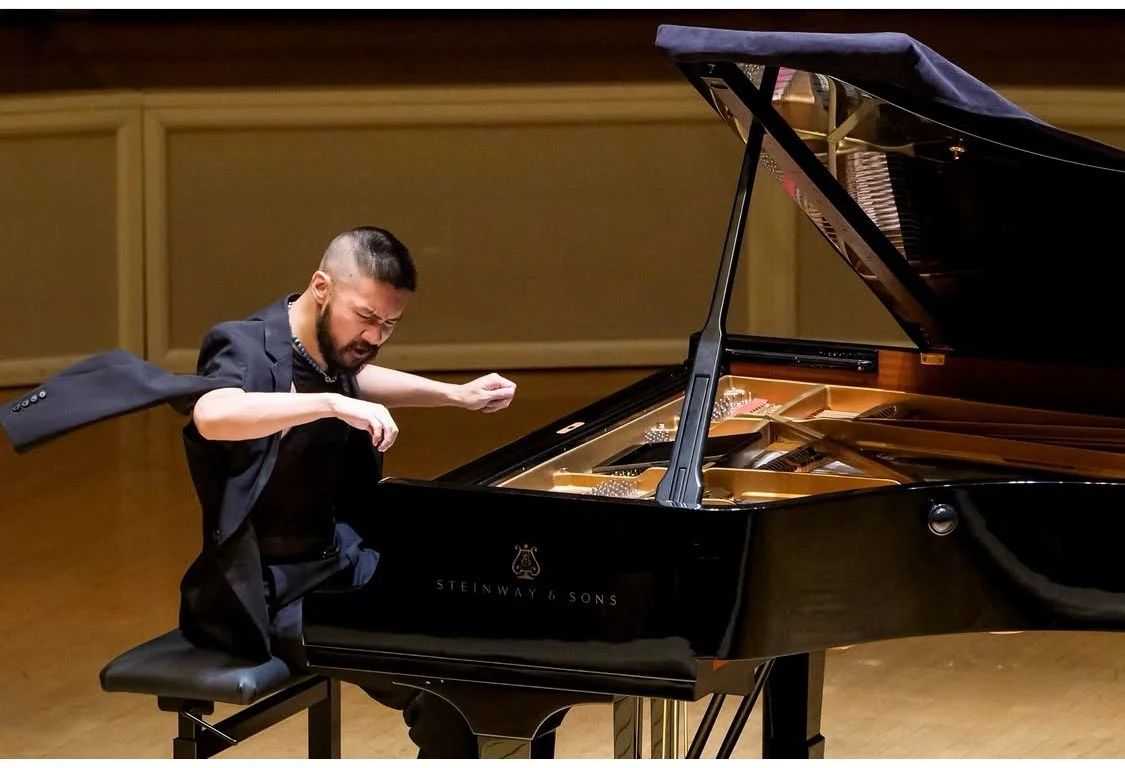
Above, photo by @toddrphoto.
June 5, 2026
Conrad Tao, one of today’s most compelling artists, offered a thrilling performance as part of Kaufman Music Center’s 100 Years of American Piano Music, a two-night festival curated by Anthony de Mare. Tao’s virtuosity is limitless and his intellect formidable. But his imagination and emotional acuity are what transform his highly conceptual piano recitals, such as this evening’s Broken Lines, into persuasive artistic statements.
Merkin Hall, which with its blonde wood usually feels like rec room designed by Ikea, was disguised in moody, dark blues. Tao was styled in a Walter Van Beirendonck blazer with the armpits cutout — a visual actualization of the concept of broken lines, as well as a pianist’s escape from the confines of sleeves.
Tao was so grounded in this series of American works that explored “lines that are refracted or fragmented,” as he described it, you wouldn’t have suspected that earlier in the week he played Gershwin’s Concerto in F with the Pacific Symphony, Felipe Lara’s Injust Intonations at National Sawdust, two days later would play a completely different solo concert in Chicago (including Rachmaninoff’s Paganini Rhapsody and Gershwin’s Rhapsody in Blue), and the following week, a Mozart concerto in Tokyo.
Broken Lines was culled from material he covered on his albums American Rage and Pictures, but his ability to juggle this volume of repertoire is mind boggling, especially given the sensuality and zest for life he brings to his playing.
A specialist in the music of David Lang, Tao opened with cage, composed in memory of John Cage. He described the piece as a “gentle undulating curve displaced across the keyboard,” and played the seemingly formless piece like a hypnotism, suspending a constellation of pulsating repeated notes, like a mime tracing the contours of an imaginary box.
He followed with music by Elliott Carter, whose very aesthetic defined the program’s theme: as Tao put it, “multiple layers of lines, across different time scales,” creating “unpredictable points of interaction and unpredictable structures.” Carter’s Two Thoughts About the Piano form “mirror images:” Intermittences, written in 2005 for Peter Serkin, inspired by a chapter in Proust called ‘Intermittences du Coeur,’ explores “gaps and holes in our memory.”
Tao made poetic sense of this thorny music — Webern meets Thelonious Monk — drawing color, texture, and drama from the Steinway like an abstract painter. He then propelled into 2007’s Caténaires — a whipping, monophonic line (one note at a time, no chords) composed for Pierre Laurent Aimard — with the kinetic propulsion of a hydraulically launched roller coaster.
Julia Wolfe’s Compassion was a response to the events of 9/11, in tribute to composer Ruth Crawford Seeger (the name Ruth means compassion). Tao hears in it a “distended jagged scream,” constructed of “breakages … like tectonic plates in insistent friction.” The pianist soared melodically, rendering Wolfe’s plaintive cry with disciplined abandon, as if it were Brahms.
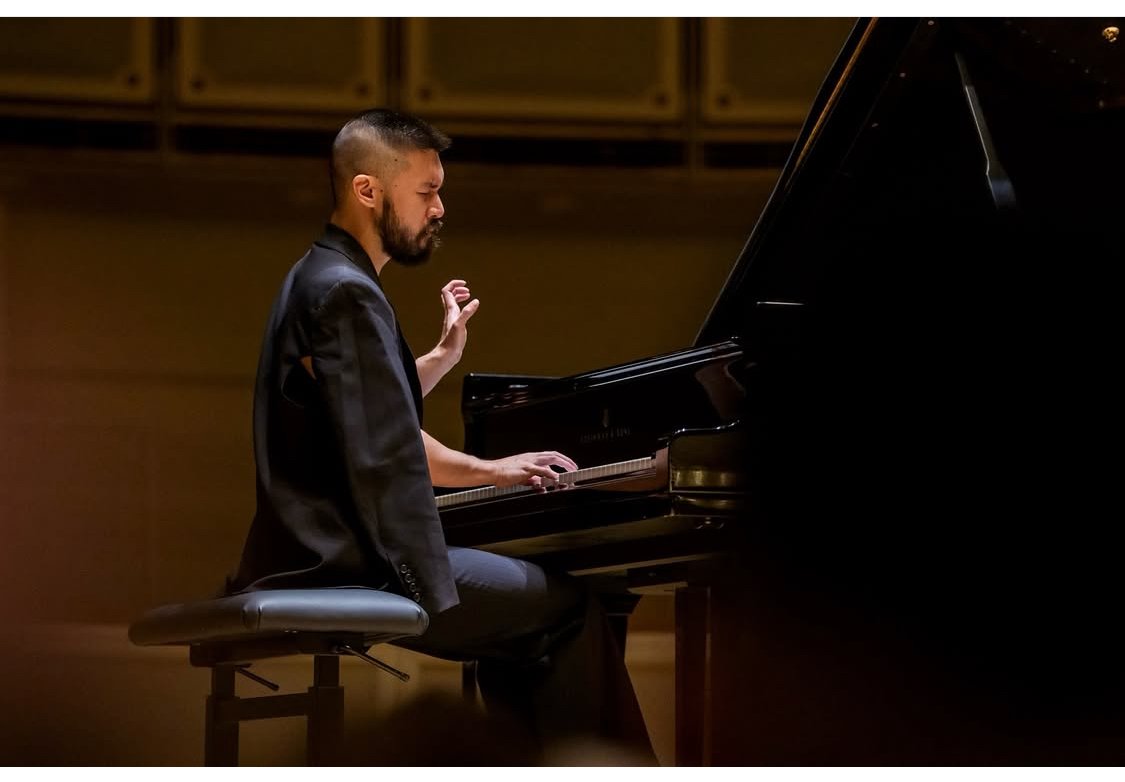
photo by @toddrphoto.
Tao’s program continued with two magnum opuses of American piano music. In Aaron Copland’s 1941 Piano Sonata, an edifice tightly constructed from a few economical gestures, rather than sink into Copland’s tempting vertical structures, Tao leaned into a singing line. He discovered in the sonata a song of Copland’s gay soul, but played Frederic Rzewski’s monumental Which Side Are You On?, a series of variations based on Florence Reese’s iconic labor protest hymn, like a biting question.
Transporting the audience to 1930s Kentucky with a vintage recording of the rustic tune, Tao dove into Rzewski’s kaleidoscopic variations with riveting precision and a shockingly varied tonal palette, this mere springboard for the evening’s most transcendent music — a lengthy, jaw-dropping improvisation by the pianist. Rzewski instructs that the optional improvisation, if played, “should last at least as long as the preceding written music.” Tao probed depths in a mesmerizing, epic fantasia on the theme’s molecules, billowing to a pianistic explosion, channeling generations of rage.