REVIEW: A Little “Knights” Music
June 23, 2026
By David Wolfson
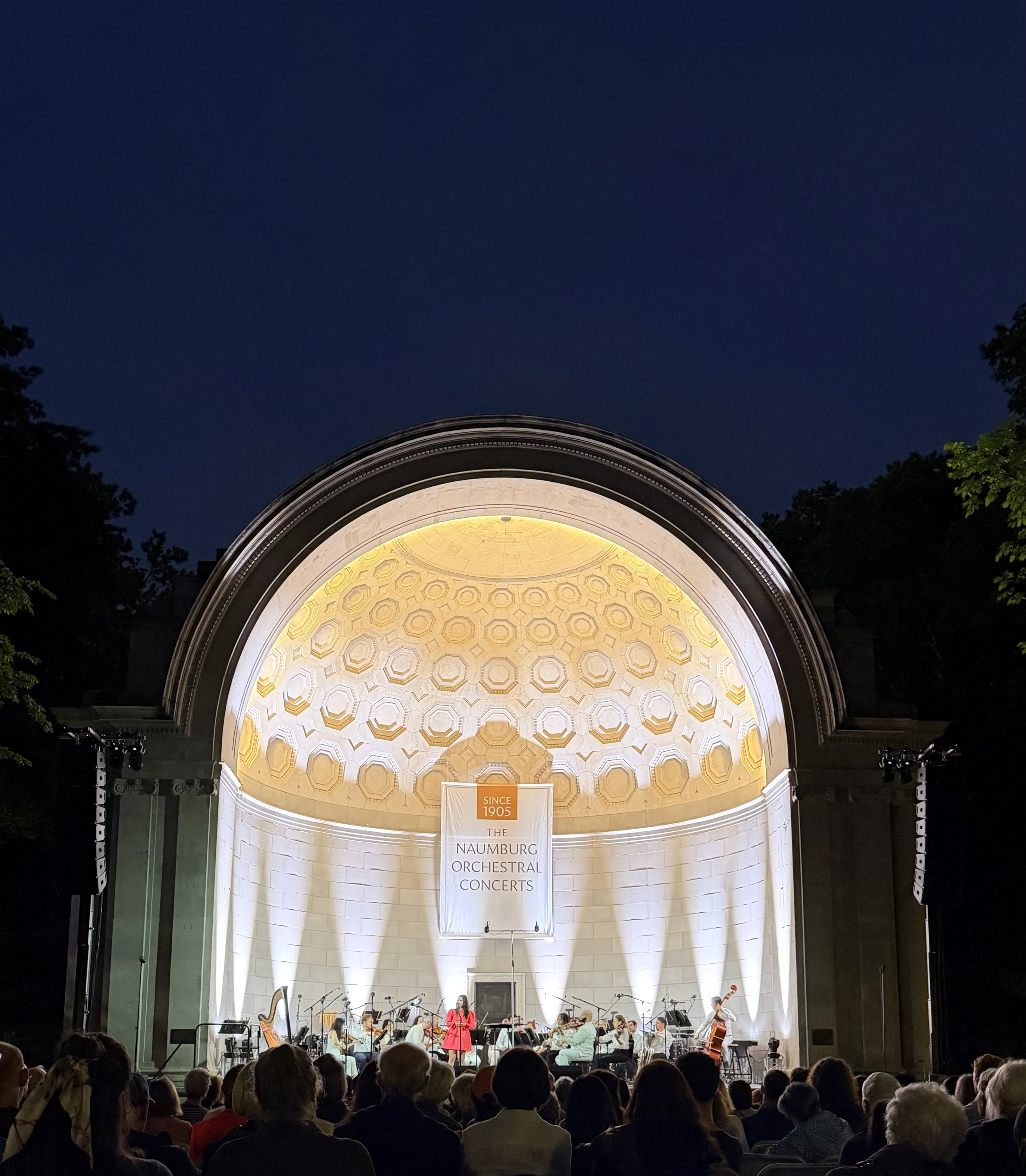
The venerable Naumburg Orchestral Concerts, like any outdoor concert series, is at the mercy of the weather. It had been raining for the past 24 hours, on and off, and had only stopped recently when the audience began arriving and started toweling off their folding chairs; you could still practically hear the administrative sighs of relief echoing around Central Park. Naumburg was presenting The Knights, a Brooklyn-based chamber orchestra under the artistic direction of brothers Colin and Eric Jacobsen that is in residence at Carnegie Hall and making its presence felt in wider and wider circles over the last few years. The performance was also being broadcast live by WQXR.
I got the sense that the uncooperative forecast had left a bit of scramble behind the scenes. At any rate, the audio mixers seemed to be playing catchup in certain areas. Christina Courtin’s rhapsody on being giant proof, which opened the concert, suffered the most from this; Courtin was the soloist, on both pop-style vocals and violin, and she was very difficult to hear or understand for most of it. The lyrics that I did hear were really intriguing: “Deep in my pocket/Lint from another life,” for instance. I gather that the piece was intended as a sort of episodic dreamscape between snoozing the alarm and waking up. The orchestra itself was well-mixed and crisp, with textures both soothing and gnarly coming through cleanly and evocatively. The alarm itself was rendered as a pulsation of alternate fingerings on a single flute note, a lovely bit of musical imagery.
Courtin was also the soloist on the concert’s closer, Colin Jacobsen’s able arrangement of Paul Simon’s iconic American Tune, which was similarly afflicted. It wasn’t until the encore, a rendition of the traditional tune “I’ll Fly Away,” for which she was joined as soloist on flute and vocals by The Knight’s flutist Alexandra Sopp, that I finally could hear her as clearly as I had the evening’s other soloists, about whom more in a minute.
The only work on the program without a soloist was the Barber Adagio for Strings. Conductor Eric Jacobsen led a strangely perfunctory rendition of this classic; it was brisk enough that one could be forgiven for thinking it was an Andante for Strings, and Jacobsen barely allowed the phrases to breathe. As if to apologize for the recent weather’s excesses, though, the sunset began during the piece’s opening passages to turn the remaining clouds a lovely shade of pink. And during the pregnant pause after the climax, we heard birds chirping. The meat of the concert, however, consisted of Lisa Bielawa’s Violin Concerto No. 2: Pulse, written for soloist Tessa Lark, and Caroline Shaw’s The Mountain that Loved a Bird, for which Jamie Bernstein served as narrator.
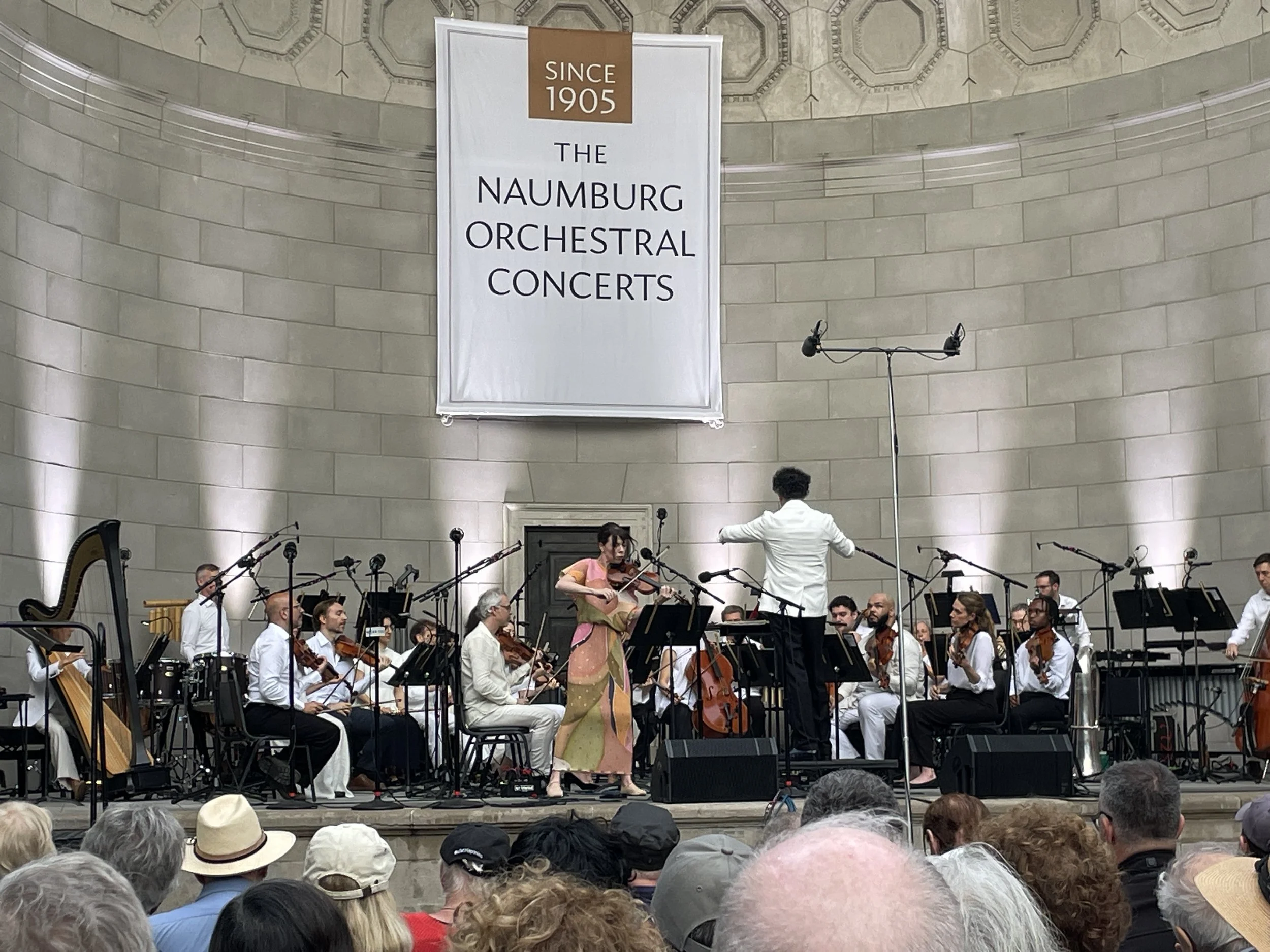
Lark is a force of nature, both an extremely accomplished classical violinist and a fierce traditional fiddler. Bielawa drew on the full range both of these aspects to create a showpiece for her that roams through and reacts to various types of American community music-making, in three movements titled “Tin Pan Alley,” “The Shapes” (as in shape-note music) and “Old-Time,” in which Lark was set loose to fiddle traditional tunes against a modernist orchestral backdrop, even switching instruments mid-movement to one with a folk tuning. “Tin Pan Alley” put recognizable melodic and orchestrational tropes in a blender, or perhaps morphed them into one another, without ever letting the ear land. Bielawa took full advantage here of the fact that this ensemble is roughly the same size and makeup as a Golden Age Broadway orchestra, and treated the solo part most like a classical concerto, including ridiculously high passages in harmonics, which Lark rendered with razor precision. “The Shapes,” in which Lark played wistful fragments of hymn tunes against tense swells of cross-rhythms from the orchestra, functioned well as a slow movement. While Lark was amplified appropriately, the amplification did have the effect of flattening out the textures; I would love to hear this piece again in a concert hall.
Eric Jacobsen and The Knights are excellent accompanists with this kind of material, and they played immaculately and expressively in both this and the Shaw. The Mountain that Loved a Bird is based on the children’s book by Alice McLerran; here Shaw’s music essentially takes the place of Eric Carle’s illustrations. Jamie Bernstein gave an effective reading of the piece, dealing well with the perhaps excessive repetition of the story. Despite seeing the story’s resolution coming from a mile away, I was still moved by its arrival. Eric Carle, the original illustrator, is best known as the author of the beloved The Very Hungry Caterpillar. It is meant as a huge compliment when I say that Shaw’s music matches his work in vividness, originality and somehow comfort all at the same time.
***
David Wolfson holds a PhD in composition from Rutgers University, and has taught at Rutgers University, Montclair State University and Hunter College. He is enjoying an eclectic career, having composed opera, musical theatre, touring children’s musicals, and incidental music for plays; choral music, band music, orchestral music, chamber music, art songs, and music for solo piano; comedy songs, cabaret songs and one memorable score for an amusement park big-headed-costumed-character show. You can find more information here.