REVIEW: Chamber Music in Perpetual Motion
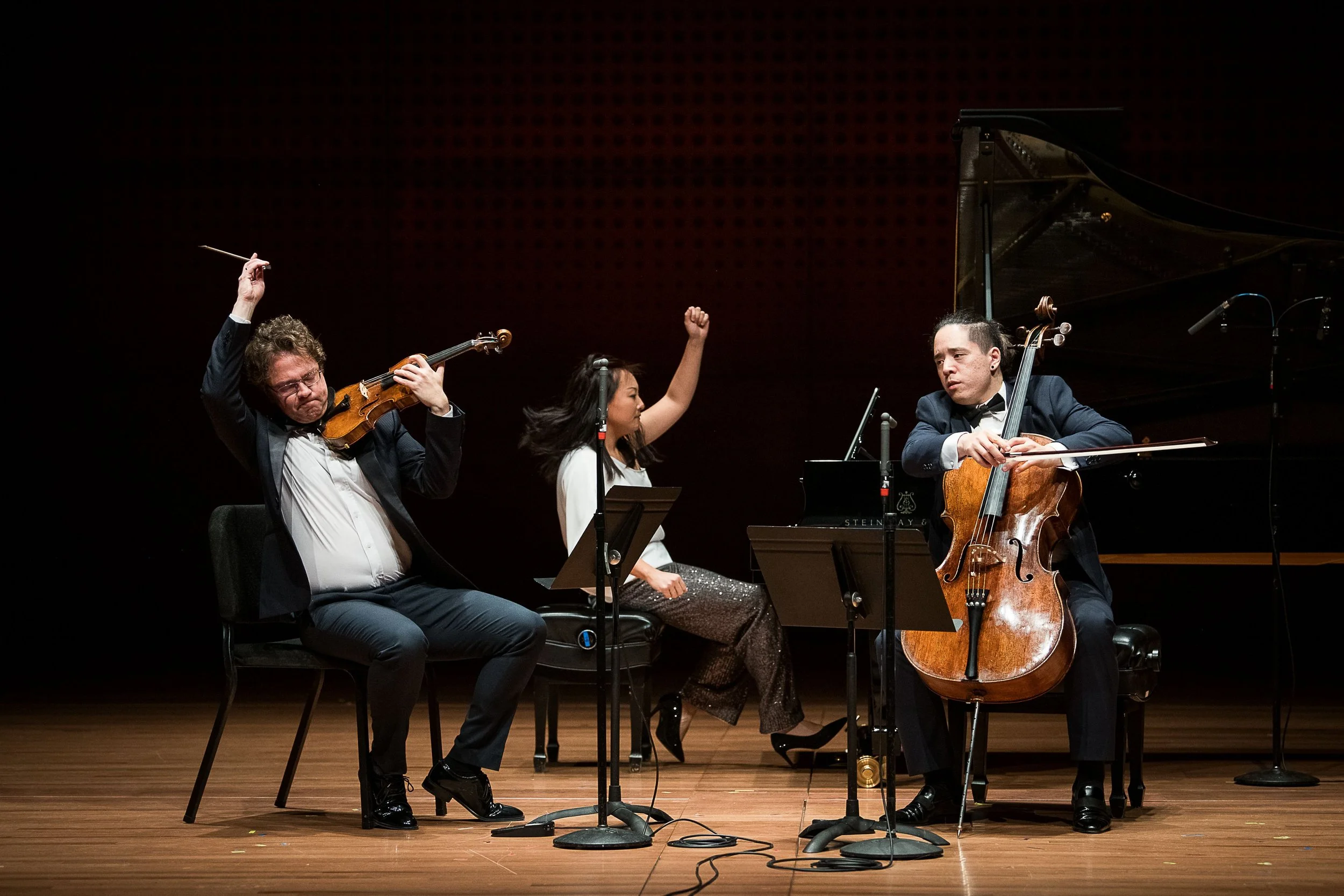
Above photo by Cherylynn Tsushima.
March 31, 2026
A glance at Chamber Music Society of Lincoln Center’s promising 2026-2027 season reveals an organization in perpetual motion. The upcoming year, a celebration of America’s 250th anniversary, features an abundance of thoughtfully constructed concerts, furthering CMS’s position as one of the most impressive exhibitors of chamber music in the country.
CMS’s latest program, a celebration of the ‘perpetual motion,’ Moto Perpetuo, was a great example. The evening gathered a team of superb musicians to play musical chairs in a nicely balanced program of pieces each concluding with a movement in the tradition of the moto perpetuo, a composer’s sure-fire crowd-pleasing finale — a musical demonstration of Newton’s first law.
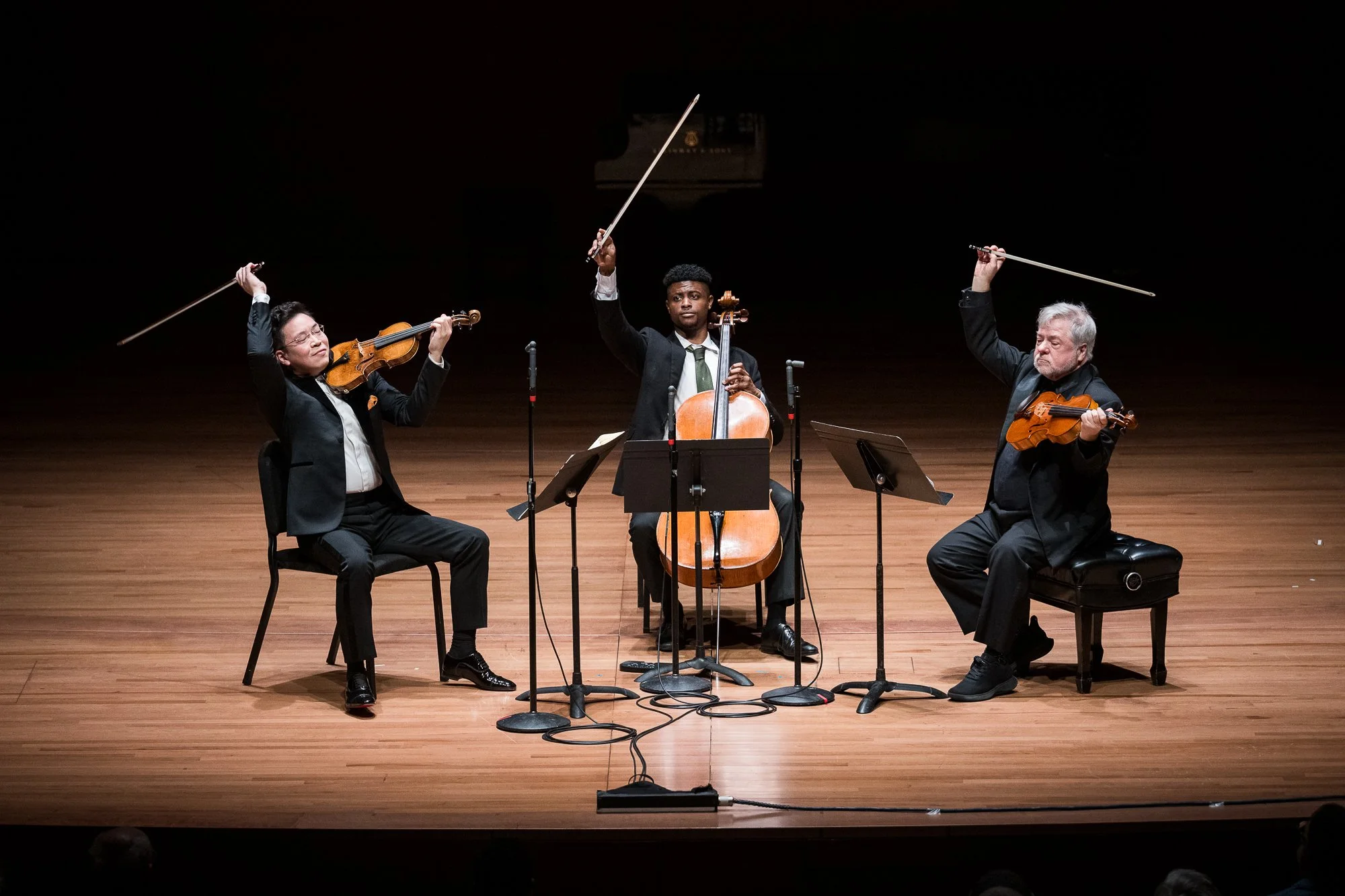
Beethoven’s Trio in G major , Op. 9, No. 1 , an early work for violin, viola, and cello, finds the young composer warming up in preparation to compose his revolutionary string quartets. Violinist Paul Huang’s Guarneri del Gesù fiddle had a bright timbre that dominated Daniel Phillips’s viola and Sterling Elliott’s cello, but the three gave the piece a solid, well-coordinated reading. Beethoven’s personality peeks through, even if the first movement develops tentatively, and the scherzo is uncharacteristically polite. The slow movement, a long-lined Adagio, ma non tanto, e cantabile plumbed some emotional depths, and the Presto finale, in fulfilling its role in the mode of moto perpetuo, called upon Beethoven’s cleverness, combining energized momentum with breaths of fresh air.
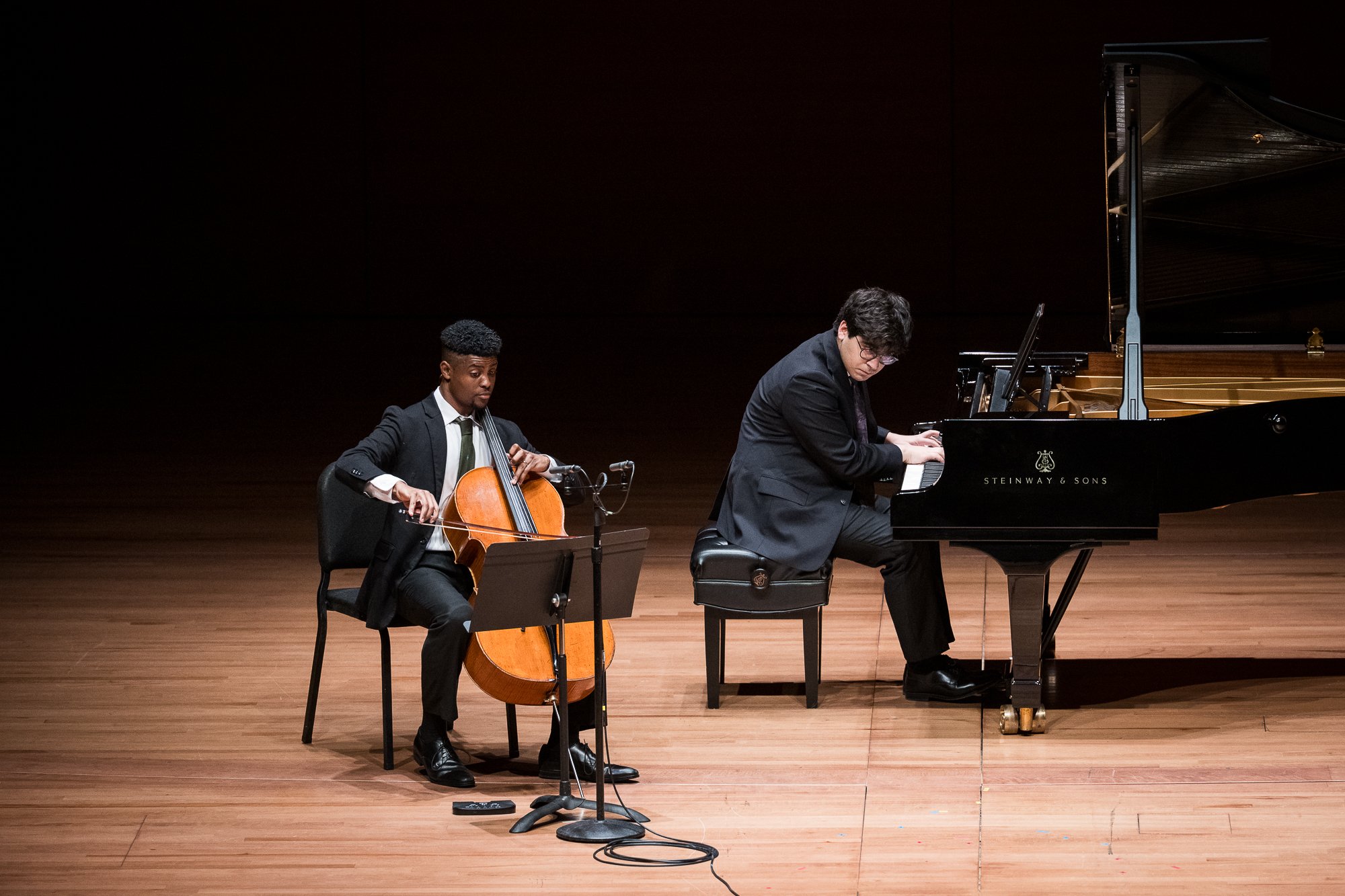
Sterling Elliott and Evren Ozel. Photo by Cherylynn Tsushima.
The concert’s primary draw, for me, was the rare appearance of Benjamin Britten’s thrilling Sonata in C major for Cello and Piano, Op. 65, composed in 1960 for the iconic cellist Mstislav Rostropovich. Elliott was joined by pianist Evren Ozel, Bronze Medalist of the 2025 Van Cliburn International Piano Competition, in a sweeping, virtuosic interpretation that proved they are both at the top of their game.
In the first movement, Dialogo, Britten marks the cello’s opening melody “lusingando” (caressing), which Elliott conveyed alluringly, as the duo’s dialogue unspooled in sweeping, effusive paragraphs. The Scherzo - pizzicato that followed was skillfully dispatched, if Ozel’s crisp runs were showier than Elliott’s subtle fingerwork. The grim Elegia and fiery Marcia, with their varied textures and expertly balanced writing, provided opportunity for the two players to stretch each other’s temperaments. The concluding Moto Perpetuo, in which the instruments toss an anxious, jumpy tarantella-like tune back and forth until linking up in an explosive unison, was riveting.
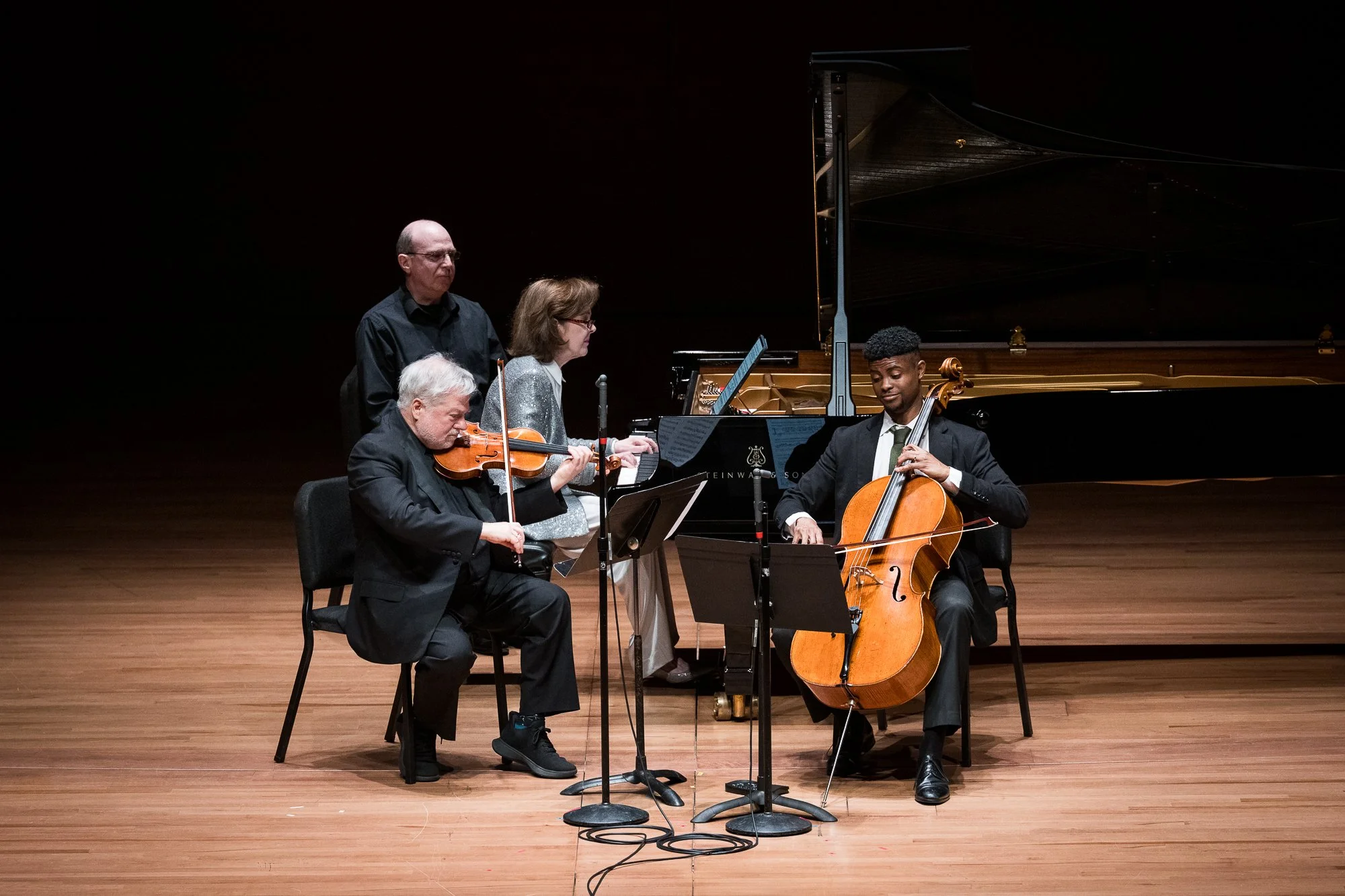
Photo by Cherylynn Tsushima.
Following intermission, Elliott returned with Phillips on the violin, joined by the always excellent Anne-Marie McDermott on the piano, for Haydn’s Piano Trio in G major, Hob. XV: 25. The slow movement, Poco adagio, was especially beguiling, but the work’s finale, Rondo all’Ongarese: Presto, fulfilled the perpetual motion requirement with some spicy (for 1795) Romani fiddle dancing and the high-velocity control of a whirling dervish.
Huang and McDermott’s virtuosic account of Camille Saint-Saëns’s Violin Sonata No. 1 in D minor, Op. 75, served as a thrilling climax. A substantial feast of ripe French romanticism, Saint-Saëns’s score makes immense demands upon the violinist, and Huang demonstrated mastery of both the piece’s ambitious architecture and its roller-coaster ride of soaring high singing lines, and swooping and diving passagework.
McDermott gave a masterclass in the art of collaborative pianism, gracefully stirring fistfuls of rippling arpeggios into a velvety sauce that didn’t upstage Huang in the foreground. The tender Adagio blossomed like an operatic aria and the Allegretto moderato had the poise of a corps de ballet’s intermezzo. But it was the jaw-dropping perpetual motion conclusion that propelled the audience to its feet before the final cadence had reverberated, sending them into the street with a jolt of caffeine.
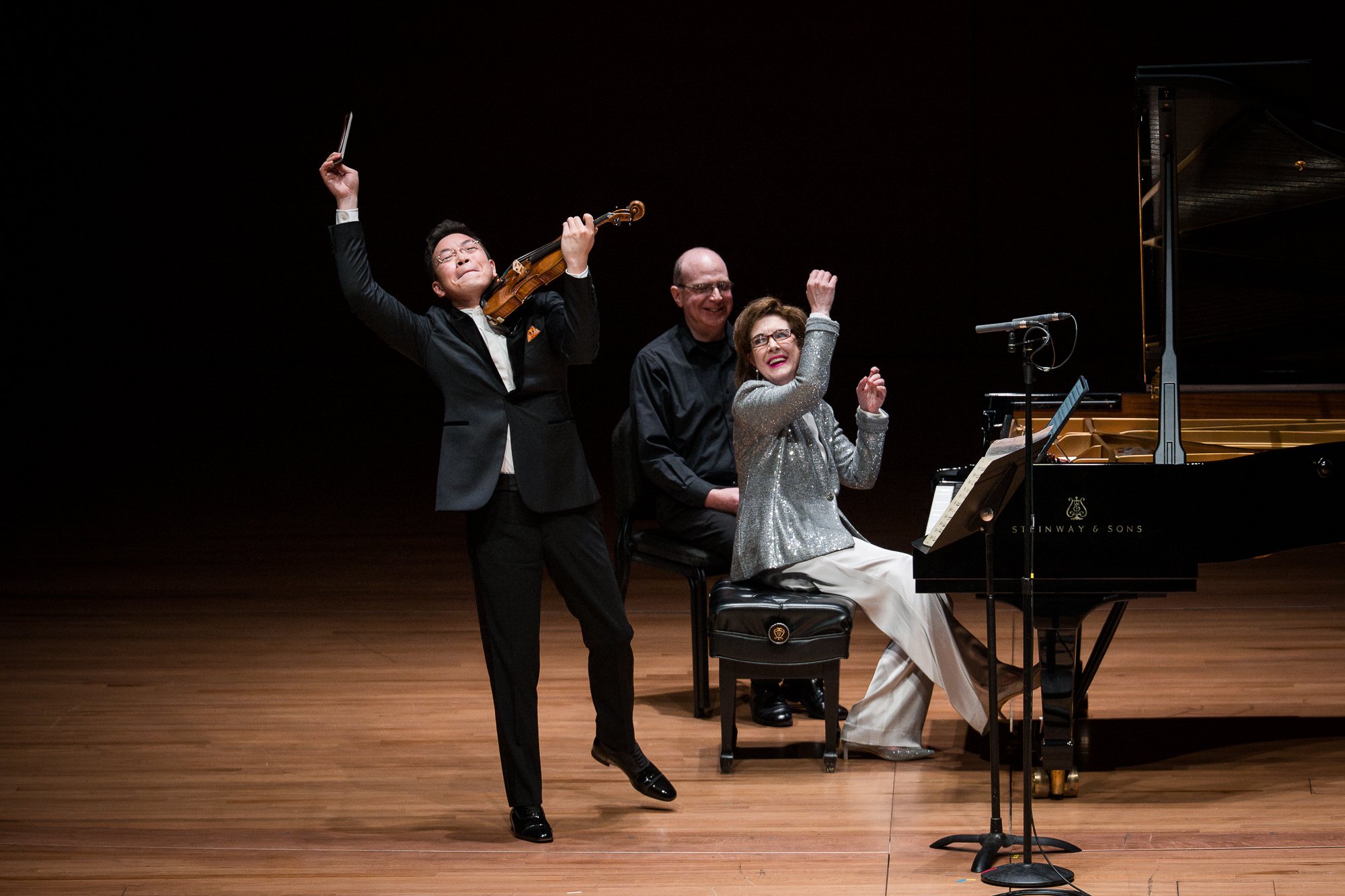
Paul Huang and Anne Marie McDermott. Photo by Cherylynn Tsushima