REVIEW: Jonathan Biss Expresses the Unexpressible
Above, Jonathan Biss. Photo by Robin Herrod.
May 12, 2026
“Music expresses that which cannot be said and on which it is impossible to be silent,” wrote Victor Hugo — a sentiment echoed by Hans Christian Andersen’s observation that “Where words fail, music speaks,” and by Leonard Bernstein’s assertion that music “can name the unnameable and communicate the unknowable.”
Jonathan Biss, acclaimed pianist, writer, and educator whom the New York Times has called “one of his generation’s most serious musical thinkers,” pondered music’s power to transcend speech in an ingeniously curated recital at Kaufman Music Center’s Merkin Hall called Words Fail!
Biss opened his gambit with three of Felix Mendelssohn’s elegant and intimate Songs without Words. Mendelssohn’s forty-eight art songs without voice or text exemplify the Romantic notion that the piano could “sing.” Biss’s warm, yet urgent, renderings focused on the melody, while keeping the background texture crisp.
Leoš Janáček’s cycle of character pieces On an Overgrown Path are wordless songs, of a sort, as well. The sixth piece, “Words Fail!”, provided a thesis statement for Biss’s program. A tantalizingly brief detour to the Czech composer’s unique sound world, the piece vividly captures the sensation of tripping over one’s words, but Biss’s dexterous fingers blurred the more agitated moments. Hungarian composer György Kurtág’s Games (Játékok) supplied two further variations on the theme: the distilled and fragmentary Quiet Talk with the Devil and the mysteriously laconic Silence.
This group of three brief pieces, explicit examinations of the limits of spoken language, transited to the exquisitely expressive world of that quintessential Romantic, Robert Schumann. Biss rounded out the evening’s first half with Schumann’s final piano work, 1854’s Ghost Variations (Geistervariationen), WoO 24. Composed at the height of a mental health crisis, the theme and five variations is thus titled because Schumann received the theme (actually a chorale-like tune he had employed repeatedly in earlier years) from what he perceived as spirits or ghosts. The piece was closely guarded by his widow Clara, and not published until 1939.
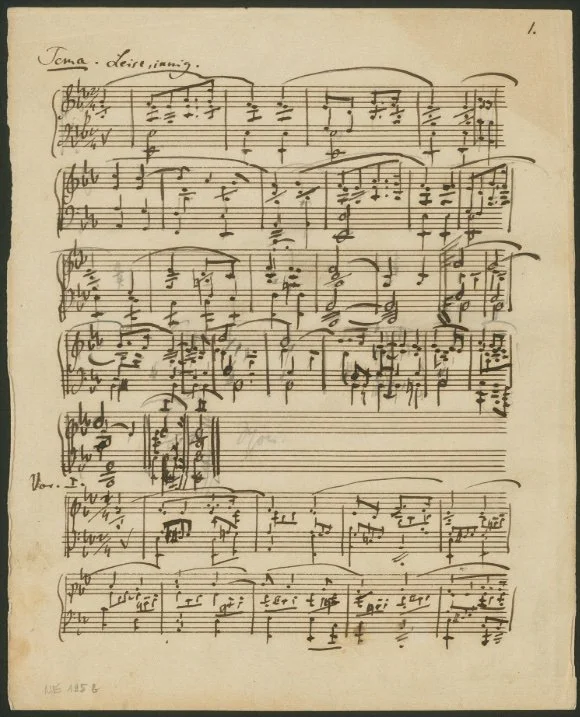
Schumann’s autograph manuscript of the Ghost Variations, WoO 24
Biss channeled the tender work’s confessional intimacy. With remarkable control of pianissimo voicing, his foot scarcely leaving the una corda pedal, the pianist conjured an atmosphere that oscillated between erotic whisper and deathbed farewell.
1839’s more loquacious Fantasie in C Major, Op. 17, a landmark of nineteenth century piano music, is less fragile, placing its threadbare emotions on a grand musical canvas. A first-person narrative of being on pins-and-needles permeates the three movements, and Biss built an architectural structure from the yearning, soaring first movement, through the joyously manic middle movement (flawlessly darting through the notorious leaps), culminating in the sublime third movement.
Biss’s command of legato line and sweeping phrasing shaped the movement into another song without words. As an encore, he offered, naturally, Schumann’s “The Poet Speaks,” from Kinderszenen, a fitting epilogue to an evening contemplating sincerity.